Which Industrial Hose Is Best for Sandblasting Applications?
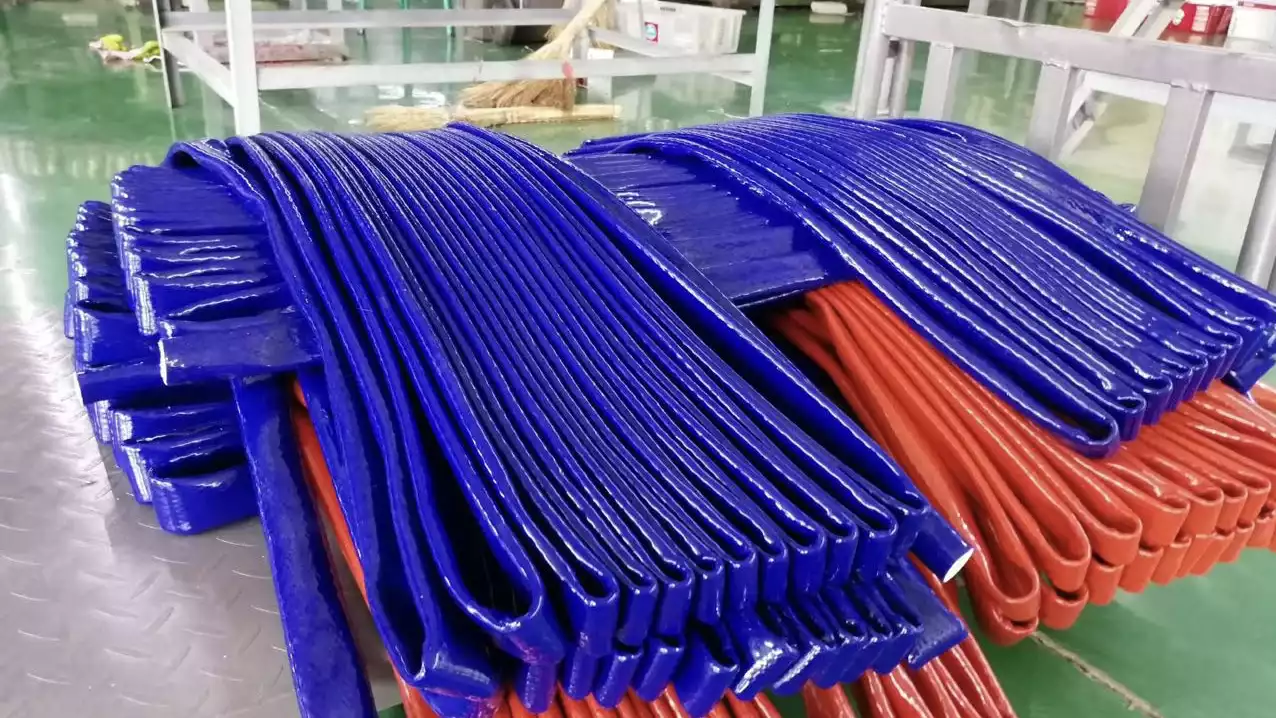
For most sandblasting work, the best choice is a purpose-built natural-rubber blast hose with a thick abrasion-resistant tube, textile reinforcement, static-dissipating construction, and a weather-resistant cover. Parker Series 7244, for example, is rated to 300 psi (21 bar), uses a 3:1 design ratio, operates from -20°F to 160°F (-29°C to 71°C), and records less than 60 mm³ abrasion loss under DIN 53516/ISO 4649 testing. Hose ID should normally be about 3–4 times the nozzle-orifice diameter. A 3/8-inch nozzle, for instance, commonly pairs with a 1-1/4-inch blast hose rather than a standard compressed-air hose.
Sandblasting hose handles two jobs at the same time: containing compressed air and carrying abrasive particles at high speed. Ordinary air hose is designed mainly around pressure, temperature, bending, and environmental exposure; blast hose adds a much thicker wear layer because garnet, steel grit, aluminum oxide, slag, or mineral abrasive continually rubs and strikes the bore.
Parker's 7244 specification shows how different that construction can be. Its natural-rubber tube is static dissipating, the reinforcement uses multiple textile plies, and the cover uses a synthetic-rubber blend. Sizes from 1/2 inch through 2 inches are listed at 300 psi maximum working pressure, with a 3:1 design ratio.
Pressure rating alone does not tell you how long a blast hose will last. A 300 psi air hose and a 300 psi abrasive hose may carry the same pressure, but only one was built to tolerate thousands of abrasive impacts against the tube wall every second.
Tube wear becomes heavier when abrasive changes direction. On a straight run, particles move largely along the hose axis; at a tight bend, particle inertia sends more material toward the outside radius. Repeated sharp bends therefore produce uneven wall wear, even when the exterior still looks normal.
The tube compound deserves close attention for that reason. Parker reports an abrasion loss below 60 mm³ for Series 7244 when tested to DIN 53516, ASTM D5963, or ISO 4649. A lower volume loss under the same test method indicates less material removed during the standardized abrasion test; numbers from unrelated test procedures should not be compared as though they were identical.
| Specification to check | Typical industrial reference | Why it matters in blasting |
|---|---|---|
| Hose ID | 1/2–2 in. | Controls airflow and pressure loss |
| Working pressure | 175–300 psi on common commercial designs | Must stay above system operating pressure |
| Design ratio | 3:1 on Parker 7244 | Provides separation between working and burst conditions |
| Temperature | -20°F to 160°F | Covers many outdoor and industrial jobs |
| Reinforcement | 2 or 4 textile plies | Affects body strength and handling |
| Abrasion test | <60 mm³ on Parker 7244 | Gives a measurable tube-wear reference |
Diameter has just as much influence on field performance as tube material. Clemco recommends blast-hose ID at roughly 3–4 times the nozzle-orifice diameter and bases its published airflow ranges on blasting at 100 psi. A 1/4-inch nozzle can use a 1 to 1-1/4-inch blast hose, while a 1/2-inch nozzle is paired with about 1-1/2-inch hose.
That relationship matters because a nozzle does not receive compressor pressure automatically. Air loses pressure while traveling through piping, valves, fittings, couplings, and hose. Longer runs and smaller bores increase restriction, so an undersized hose can leave the nozzle with substantially less pressure than the gauge reading near the compressor.
Clemco's equipment guide illustrates the airflow involved. At 100 psi, its recommended range rises from 81–137 cfm for a No. 4, 1/4-inch nozzle to 338–548 cfm for a No. 8, 1/2-inch nozzle. The same guide calls for increasing minimum air-hose ID from 1-1/4 inches to 2 inches as nozzle size grows.
A practical hose purchase should therefore start with four measurements rather than a brand name:
-
nozzle-orifice diameter and expected wear during service;
-
compressor delivery in cfm at the required pressure;
-
total air-line and blast-hose length;
-
abrasive type, particle size, and daily operating hours.
Reinforcement comes next. Two-ply and four-ply hoses are both common, but ply count should not be treated as a simple quality score. Clemco lists Two-Braid, Two-Ply, and Four-Ply blast hoses at the same 175 psi working-pressure rating, while their construction and handling characteristics differ.
Two-ply hose normally offers easier movement near the operator, particularly when several feet of hose must be repositioned around structural steel, tanks, castings, or large fabrication work. Four-ply construction gives the hose a stiffer body and greater resistance to external abuse, which can be useful in shipyards, fixed blast areas, and high-traffic work zones.
Clemco describes its four-ply design as suitable for areas where hose may encounter vehicle traffic, while its two-ply design uses a smaller wall dimension to improve flexibility. Both still require proper inspection; reinforcement can be damaged by repeated crushing even when the cover does not immediately split.
Static control must also be considered because dry abrasive moving through a hose can generate electrical charge. OSHA 29 CFR 1910.94 requires the blast nozzle to be bonded and grounded where flammable or explosive dust mixtures may be present, while commercially available blast hoses often use conductive or static-dissipating rubber compounds as part of the system.
A static-dissipating tube should still be used according to the hose maker's assembly instructions. Couplings, nozzle holders, bonding arrangements, and equipment grounding need compatible construction; replacing one component with an unverified part can change the electrical path even though the hose itself appears suitable.
Temperature gets less attention because most blasting discussions concentrate on abrasion. Parker specifies -20°F to 160°F (-29°C to 71°C) for Series 7244, giving a 180°F operating span. Work outside a manufacturer's stated range can change rubber stiffness, flexibility, sealing behavior, and resistance to cracking.
External conditions matter as well. A hose dragged across concrete, steel decking, gravel, scaffolding, and workshop floors receives wear on both sides of its construction: abrasive is removing material internally while the cover is being scraped externally. A weather- and abrasion-resistant cover therefore serves a different purpose from the thick natural-rubber tube underneath it.
Hose mass can become noticeable during long shifts. Parker lists its 1-inch 7244 hose at approximately 0.95 lb/ft, or 1.42 kg/m; a 50-foot length therefore weighs about 47.5 lb before couplings and before accounting for the abrasive-air stream. Its 2-inch version rises to approximately 1.61 lb/ft.
That weight explains why some systems use a more flexible hose section near the nozzle while keeping heavier hose farther upstream. The arrangement should remain within manufacturer requirements because reducing ID near the operator can increase restriction, while a very long flexible section can wear faster if it is repeatedly folded into small-radius bends.
Do not judge remaining hose life from the outer cover alone. Internal erosion can reduce tube thickness at bends and coupling areas before obvious external damage appears.
Inspection should concentrate on places where wear is likely to accumulate: the first sections after couplings, frequently bent areas, sections resting against sharp edges, and any location that has been run over or kinked. Changes in diameter, localized softness, exposed reinforcement, bulging, cuts, or coupling movement are reasons to remove the assembly from operation and assess it under the manufacturer's procedure.
OSHA's abrasive-blasting requirements also put hose choice inside a larger occupational-safety system. Under 29 CFR 1910.94, respirable dust levels must be controlled, blasting enclosures require appropriate exhaust ventilation, and NIOSH-approved respiratory equipment is required in specified blasting conditions. Equipment selection cannot compensate for inadequate dust control or respiratory protection.
Abrasive selection further changes hose wear. Steel grit is dense, aluminum oxide is hard and angular, glass beads are rounded, and garnet is commonly supplied in angular particles. Two hoses running at the same 100 psi can therefore experience different wear rates when abrasive hardness, shape, size distribution, feed rate, and bend geometry are different.
For buyers comparing product sheets, comparable test methods are more useful than marketing terms such as “heavy duty.” An abrasion result stated under ISO 4649 or ASTM D5963 can be checked against another hose tested under the same procedure; a manufacturer-specific wear claim without test conditions gives much less information.
Application also determines whether sandblast hose is appropriate at all. A blast hose is intended for positive-pressure abrasive delivery, while abrasive recovery by suction uses another construction. Parker's SW409 sand-recovery hose, for example, adds a dual wire helix for vacuum service and is rated to 200 psi with a 3/16-inch natural-rubber tube.
Fire exposure needs separate treatment as well. A normal blast-hose cover is not automatically a fire-protection layer. Where nearby hydraulic lines face radiant heat, hot metal, welding sparks, or molten splash, a hydraulic hose fire sleeve may be specified for the hydraulic circuit, but it should not be assumed to turn an abrasive-blast hose into a fire-rated assembly.
Before ordering, compare the proposed hose against the actual system rather than using one preferred specification for every job. A useful purchasing sheet can record nozzle size, hose ID, maximum working pressure, design ratio, tube compound, abrasion-test method, temperature limits, electrical properties, reinforcement plies, coupling compatibility, and hose weight per foot.
For a 3/8-inch nozzle operated around 100 psi, for example, Clemco's published guide points toward roughly a 1-1/4-inch blast hose and an airflow range of 196–254 cfm. Moving to a 1/2-inch nozzle can raise the published airflow range to 338–548 cfm and calls for about a 1-1/2-inch blast hose, so simply retaining the smaller hose can restrict a substantially larger air requirement.
In regular industrial blasting, a thick natural-rubber tube, measurable abrasion performance, suitable ID, textile reinforcement, static-dissipating construction, and a cover made for industrial handling generally provide the most appropriate combination. A hose rated at 175 psi may be fully suitable for one machine, while another installation may call for a 300 psi product; the correct rating comes from the equipment pressure and manufacturer limits rather than choosing the largest number on the catalog page.