A Year of Listed Fees at 1,848 TH/s, Priced in Bitcoin and Dollars
1,848 TH/s earns 0.00082911 BTC a day, which is $70.21 at $84,692 and $67.40 after the listed 4% on the block-reward component. One day is easy to ignore. Multiply the fee line by 365 and it becomes $1,025.07, a figure large enough to sit in a budget beside power and hardware.

Key takeaways
- At 1,848 TH/s the daily gross is $70.21 and the listed 4% line is $2.81.
- Annualised at today's inputs, that fee line is $1,025.07, or 0.0121 BTC.
- The yearly figure is a planning number, not a forecast: difficulty and price both move it.
- Hold the amount as a reserve rather than treating it as money already earned.
Why annualise a daily charge
A fee charged per day is designed to feel small. Two dollars and eighty-one cents against seventy dollars of income reads as a rounding error, and in any single day it is. The same charge over a year is a figure that belongs beside a repair bill or a month of hosting, and comparing it with those items is what makes the size visible.
Annualising also makes the fee comparable with the other annual costs an operator already tracks. Insurance, maintenance, freight and the electricity contract are all reviewed on a yearly basis. Putting the pool charge on the same footing ends the habit of treating it as a background deduction that never gets examined.
Three things that move the yearly number
Difficulty is the first. The estimate read on 21 Sept 2026 pointed to −2.12%, which would raise output per terahash slightly; a sustained rise would do the opposite. The annual fee follows gross income, so a year of rising difficulty produces a smaller fee total on the same hardware — and a smaller net, which is the part that matters.
BTC price is the second. The schedule is charged in coins and reported in dollars, so a lower price shrinks the dollar figure without changing the coin figure. That is why the annual total should be carried in both units; the BTC line is stable against hashrate, while the dollar line is a snapshot at $84,692.
The third is the transaction-fee share. In a busy mempool the fee component grows, and the cheaper 2% rate applies to more of the gross. The blended deduction therefore drifts below 4% in exactly the periods when income is highest, which is a small but real comfort in the annual arithmetic.
The scheme behind the annual line
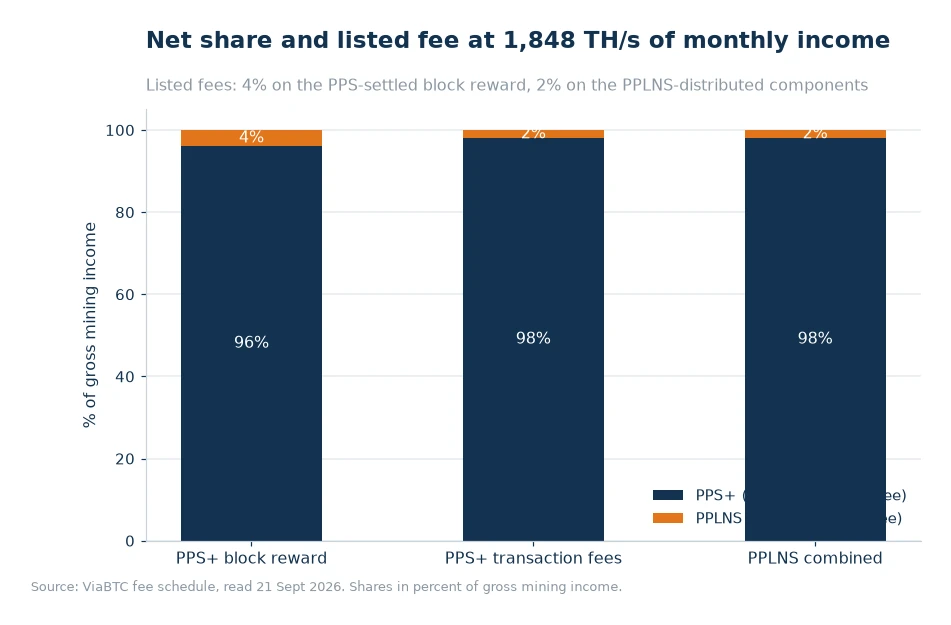
The total above assumes the default arrangement, PPS+, where the subsidy slice carries the listed 4% and the transaction-fee slice carries the listed 2%. Annualising that structure means the 4% line scales with block reward while the 2% line scales with fee income, which is why a year of busy blocks and a year of quiet ones do not produce the same blended rate.
Run the same hardware on PPLNS instead and the picture changes at the base. Block reward and fees are combined, the listed 2% applies to the combined figure, and the operator takes on pool luck. The annual fee is smaller on paper, but the income is lumpier, so the reserve has to cover a gap as well as the charge. The ViaBTC Pool Fees page sets out both structures, and reading them side by side is a five-minute exercise that prevents a year of guessing.
Whichever scheme is chosen, keep the annual figure in the same scheme it was calculated under. Mixing a PPLNS year with a PPS+ month produces a comparison that means nothing, and the error is easy to make when the numbers live in different tabs.
What the number is good for
Three uses, in order of value. First, it sizes a reserve: an operator who knows the fee line for a year can decide how many months of it to hold in the wallet. Second, it sets a benchmark for renegotiation or for comparing schemes; a scheme change worth $300 a year is worth a spreadsheet, and one worth $12 is not. Third, it puts a ceiling on what a hosting or repair decision may cost before it eats the fee saving.
What it is not good for is predicting next year's income. The annual fee is a function of gross, and gross is a function of difficulty, price and uptime. Treat the figure as a planning input tied to today's conditions, and re-run it whenever one of those three inputs moves enough to matter.
Reading it as a share of revenue
The fee line is about 4% of gross when the transaction-fee slice is small. That is a useful anchor because it lets an operator sanity-check any statement in seconds: if the deduction looks like a tenth of the gross, something is wrong, and if it looks like a rounding error in a busy week, that is the 2% slice doing its job.
Compare that share with the other costs. Power usually dominates, hardware depreciation is second, and the pool charge sits well below both. An operation that fails is rarely failed by the pool percentage; it is failed by power, by downtime, or by hardware that never ran at its rated hashrate. Keeping the fee in proportion is how the bigger numbers stay in focus, and how a small line item gets attention without getting panic.
| Period | Gross USD | Listed 4% USD | Net USD |
|---|---|---|---|
| One day | $70.21 | $2.81 | $67.40 |
| One week | $491.47 | $19.66 | $471.81 |
| Thirty days | $2,106.30 | $84.25 | $2,022.05 |
| One year | $25,626.65 | $1,025.07 | $24,601.58 |
Worked example
Take the daily figure apart, then multiply it out.
- 144 blocks × 3.125 BTC = 450 BTC produced network-wide each day.
- 450 ÷ 1,003,000,000 TH/s = 0.00000044865 BTC per TH/s.
- 1,848 × 0.00000044865 = 0.00082911 BTC a day.
- At $84,692: 0.00082911 × 84,692 = $70.21.
- Listed 4% on the block-reward base: 70.21 × 0.04 = $2.8084, or $2.81.
- Net: 70.21 − 2.81 = $67.40 a day.
- Year: 70.21 × 365 = $25,626.65 gross, and 2.8084 × 365 = $1,025.07 in fees.
- The same fee in coins: 0.00082911 × 0.04 = 0.00003316 BTC a day, or 0.0121 BTC a year.
Frequently asked questions
Is the yearly fee fixed once calculated?
No. It tracks gross income, so difficulty, BTC price and uptime all shift it. The $1,025.07 figure holds only at 1,848 TH/s, 1,003 EH/s of network hashrate and $84,692 per BTC.
Should I set the fee aside in coins or dollars?
In coins, because the charge is taken from mining income before it reaches the wallet. Thinking in BTC keeps the reserve matched to the thing being charged, while the dollar figure is for budgeting and comparison.
Does the annual figure include withdrawal costs?
No, and there is nothing to include: mining payouts on ViaBTC are zero-fee, so the wallet receives the net credit without a separate transfer charge. Power and hardware remain outside the figure entirely.
Put the number in the budget
Add one line to the annual plan for the listed fee, in both dollars and bitcoin, and date it. Then decide how much of it to hold as a reserve. A common approach is to keep a few months of the line in the wallet rather than borrowing against future credits, which is where the Collateral-Pledged Loans question becomes relevant: a loan can cover a timing gap, but it should not be sized against a fee that is already deducted upstream.
Re-run the arithmetic each quarter with the current difficulty and price. The Profit Calculator produces the gross, and the fee follows from it. A budget line that gets reviewed four times a year is a budget line that stays honest, and it turns a charge that used to be invisible into one you can argue with.
Sources: ViaBTC fee schedule and calculator pages for the listed rates and gross estimates[1]. Snapshot of 21 Sept 2026: BTC $84,692, 1,003 EH/s network hashrate, 132.76 T difficulty, 3.125 BTC every block, 144 blocks a day. Published 24 Oct 2026; annual figures assume constant conditions.